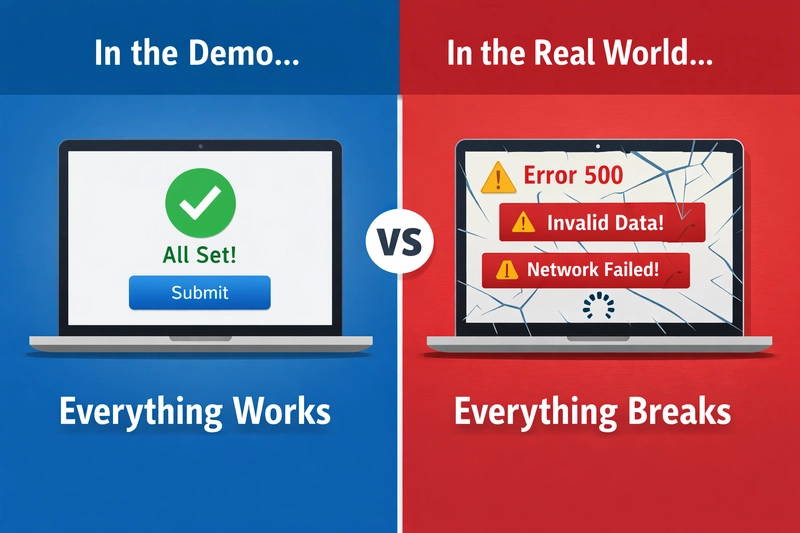
Most products don’t fail because the idea is bad.
They fail because they were never built for real users.
They were built for demos.
What a demo looks like
A demo is controlled.
You open your app.
You click through a smooth flow.
Everything works.
You feel good.
But that’s because nothing went wrong.
The internet was fast
The inputs were correct
The steps were followed in order
No one did anything unexpected
You basically designed the experience and the user just followed it.
The problem
Real users don’t behave like that.
They don’t follow your script.
Many things can go wrong.
What real users actually do
Someone opens your app.
They enter the wrong email
They use a bad phone number
They refresh halfway
They leave and come back later
They click things out of order
Their network goes off
Now your system has to deal with that.
Simple example
You build a form.
In your demo:
User fills everything correctly
Clicks submit
Sees success message
Done.
In real life:
User fills half the form
Leaves
Comes back later
Changes one field
Clicks submit twice because nothing happened
Network fails the first time
Now you have:
Duplicate submissions
Incomplete data
Confused user
If your system breaks here, then what you built was just a demo.
Another example
You build an RSVP system.
In your demo:
1 person responds
Clean data
Everything looks perfect
In real life:
300 people respond at once
Some enter wrong numbers
Some submit twice
Some change their mind
Some don’t respond at all
Now your system has to:
Handle duplicates
Track updates
Stay fast under load
That is the real test. I saw this firsthand while building Invyt, where real user behavior quickly exposed things that worked fine in testing.
The wrong assumption
When building demos, many people assume:
Users will follow the flow
Data will be clean
The network will work
Errors are rare
None of this is true.
The right mindset
When building a real product, assume this instead:
Users will break your flow
Data will be messy
The network will fail
People will do things you didn’t plan for
So you build for that.
What changes when you think this way
You stop asking:
“Does it work?”
You start asking:
“What happens when this goes wrong?”
What if they submit twice
What if the request fails
What if they leave halfway
What if 100 people do this at once
That’s where you'll begin to get it right.
The hidden cost of demos
The truth is that if you only build for demos:
Bugs show up in production
You keep patching things
Users lose trust
Your team gets frustrated
Because the product was never ready for real users.
A product is not tested when everything works.
It is tested when things go wrong.
Quick Check: Is Your Product Ready for Real Users?
Before you call it done, run through this:
Can it handle bad input? What happens if a user enters the wrong data? Do you validate and guide them, or does it just break?
What happens if the network fails? Does the action retry? Does the user get feedback, or are they left guessing?
Can users recover from mistakes? Can they go back and fix things? Or do they have to start all over again?
What if they don’t finish the flow? Is progress saved? Can they return and continue later?
Can it handle repeated actions? What if they click submit twice? Do you prevent duplicates?
What happens under pressure? If many users use it at once, does it still work? Or does it slow down and fail?
Are errors clear and helpful? Do users understand what went wrong? Do they know what to do next?
Can you see what’s going on? Are errors logged? Can you track issues when users report them?
Does it work outside your setup? Different devices Different browsers Slower connections
Can you support it after launch? If something breaks, can you fix it quickly? Or are you blind once it’s live?
Final thought
If your product only works when everything goes right,
it’s not a product.
It’s just a demo.